
Quick Summary
Prompt drywall water damage repair in Blauvelt is essential to prevent structural framing rot, gypsum breakdown, and rapid mold growth within 24 to 48 hours of a leak. Floodline Restoration Co. delivers a streamlined, single-team solution for Orangetown properties by combining thermal moisture detection and intra-wall cavity drying with full sheetrock reconstruction and direct insurance claim assistance. Homeowners will understand the differences between salvageable drywall and mandatory replacement while learning how to secure a 24/7 free visual inspection and fast repair assessment.
Drywall Water Damage Repair in Blauvelt
When dealing with drywall water damage in Blauvelt, prompt action prevents saturated sheetrock from warping framing, breaking down plaster, or promoting mold growth. Nationally, typical drywall water damage repairs generally range from approximately $500 for small, localized patches up to $3,500 or more for extensive multi-room mitigation and reconstruction, though actual local costs vary based on project scope. Because moisture trapped inside wall cavities can spawn mold within 24 to 48 hours under favorable conditions, knowing what to salvage and what to cut out makes a significant difference in both overall cost and recovery time.[1]
A professional restoration team, such as Floodline Restoration Co., typically handles the repair process across several phases: evaluating hidden moisture, structural drying, framing repairs, hanging replacement sheetrock, taping, and paint matching. Comprehensive documentation also helps simplify insurance claims by providing adjusters with detailed drying records and itemized repair estimates. See also Water Damage Restoration in Pearl River | Call Now-10% Off | Same-Day Service | Free Estimate.
What to Do Right Away for Wet Drywall in Blauvelt
If you notice bubbling paint, soft spots, or water pooling near baseboards, take these initial steps immediately:
- Shut off the source: Turn off your main water valve if the issue is a burst pipe, leaking supply line, or overflowing appliance.
- Kill the power: Switch off circuit breakers to any wet rooms or wall partitions to eliminate shock hazards.
- Do not punch random holes: Avoid breaking into bulged drywall without containment, as this can spread contaminants and mold spores into clean living spaces.
- Call for professional extraction and drying: Certified restoration technicians can evaluate the wall with moisture meters or thermal tools to help assess materials before the gypsum core disintegrates.
Can Water-Damaged Drywall Be Saved or Must It Be Replaced?
Whether your drywall can be dried in place or needs replacement comes down to two main factors: how long the wall has been wet and what kind of water caused the damage.
If clean water from a supply pipe or sink overflow is caught within 24 to 48 hours and the sheetrock has not lost its structural integrity, specialized drying equipment can often save the wall. However, if the drywall is sagging, pulling away from fasteners, or contaminated by sewage or ground runoff, it must be removed.
Mid-Century Wall Construction in Blauvelt
Many homes built between 1945 and 1968 throughout Orangetown, including classic ranches and split-levels in Blauvelt, use rock lath (small gypsum plasterboard panels covered with a plaster skim coat) or layered gypsum boards. These dense wall assemblies behave very differently than modern 1/2-inch sheetrock. They often hold gallons of moisture between the plaster layers and the wood framing while remaining completely dry to the touch on the outside paint surface.
In the past, contractors would simply tear out four feet of wall across an entire room with a standard flood cut. Today, targeted intra-wall cavity drying systems deployed by Floodline Restoration Co. can pump warm, dry air straight into the stud bays through tiny, hidden access points behind the baseboards. This approach dries the framing and back side of the plaster without wrecking the entire room.
| Feature | Intra-Wall Cavity Drying | Targeted Flood Cut (12″-24″) | Full Wall Demolition |
|---|---|---|---|
| Water Category | Category 1 (Clean supply lines) | Category 2 & 3 (Gray or black water) | Severe structural damage or old mold |
| Saves Drywall | Yes | Partial (replaces bottom section) | No |
| Response Window | Within 24-48 hours | Anytime after contamination | Long-term saturation |
| Reconstruction Needed | Minimal (reinstall baseboards) | Moderate patch, tape, and blend | Complete sheetrock rebuild and paint |
Water Contamination Categories
Industry standards define how water damaged drywall repair must be handled based on water cleanliness:
- Category 1 (Clean Water): Sourced from broken supply pipes, failing water heaters, or tub overflows. Salvageable with quick extraction, structural dehumidifiers, and cavity drying systems.
- Category 2 (Gray Water): Carries chemical or physical contaminants from dishwasher overflows, washing machine discharge, or sump pump failures. Saturated drywall and wet insulation are generally removed.
- Category 3 (Black Water): Highly contaminated water from sewer backups or outdoor flooding. Saturated drywall must be cut out at least 12 to 24 inches above the highest water mark and disposed of under strict containment.
Drywall Water Damage Repair Cost Considerations
Need drywall water damage repair in Blauvelt?
We’re available now - call for a fast, free estimate.
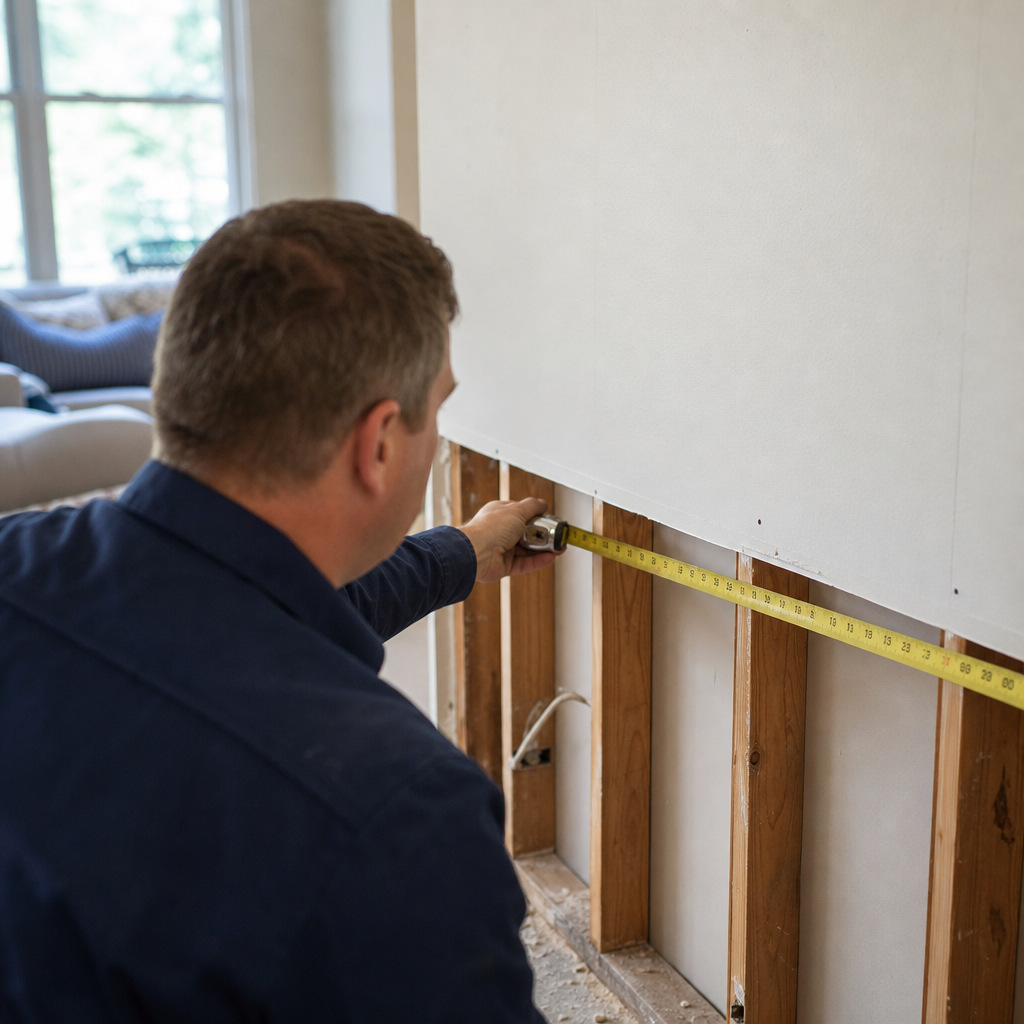
On a national level, the cost to repair water-damaged drywall typically ranges from roughly $500 for minor repairs to over $3,500 for full-room water extraction, structural drying, and sheetrock reconstruction. Actual expenses depend on the square footage affected, whether insulation requires removal, and the water category involved, rather than a fixed local rate schedule.
While municipal pricing data is not published specifically for Blauvelt, county-level environmental data provides broader context for regional moisture risks. According to the ADRI Rockland County Risk Report (2024), 13.1% of properties across Rockland County are located within FEMA-designated flood zones. When plumbing failures or severe weather events introduce water into living areas, prompt structural drying can help prevent repair costs from escalating.[2]
| Service Step | Work Included | Estimated Cost |
|---|---|---|
| Moisture Mapping & Extraction | Moisture assessment, standing water extraction | $400 – $1,100 |
| Intra-Wall Cavity Drying | Direct airflow injection, commercial dehumidification | $600 – $1,800 |
| Controlled Demolition | Removing ruined sheetrock/insulation, antimicrobial treatment | $500 – $1,500 |
| Sheetrock Reconstruction | Hanging new drywall, taping, mudding, sanding, and priming | $750 – $2,500+ |
Insurance Claim Assistance
Most homeowner policies cover sudden and accidental water damage, such as a ruptured copper pipe or a failed appliance line. To support claims processing, professional restorers like Floodline Restoration Co. generally document moisture readings, take room-by-room photos, and prepare detailed itemized estimates formatted for insurance adjusters.
How Fast Does Trapped Moisture Turn Into Mold?
As a general biological principle, mold spores can begin colonizing wet drywall within 24 to 48 hours under typical indoor conditions. Drywall is lined with organic paper, which serves as a food source for mold when wet. Once moisture enters the gypsum core, fungal growth can spread through the wall cavity where airflow is limited.
Fiberglass batt insulation behind drywall acts like a sponge. Even if the front of your wall looks dry, wet insulation holds water directly against wood framing and the back of the sheetrock. Leaving this damp creates the dark, humid environment that species like Aspergillus, Penicillium, and Stachybotrys need to flourish.
Targeted drying methods help mitigate these risks by:
- Detecting hidden moisture pockets using moisture meters or thermal inspection tools.
- Injecting high-velocity, dry air into stud cavities to evaporate moisture before fungal growth takes hold.
- Running commercial low-grain refrigerant (LGR) dehumidifiers and HEPA air filtration to manage indoor humidity and maintain indoor air quality.
Frequently Asked Questions
How quickly can emergency drywall repair crews respond?
Response times depend on contractor availability and scheduling, though many restoration providers, including Floodline Restoration Co., offer rapid or emergency dispatch throughout Blauvelt and the wider Town of Orangetown. Prompt arrival allows technicians to assess standing water and begin drying before drywall softens significantly.
Does homeowners insurance cover drywall water damage repair?
Standard homeowner insurance policies generally cover drywall repair if the water damage resulted from a sudden, accidental event, like a burst pipe or appliance malfunction. Gradual leaks caused by deferred maintenance are often excluded. A detailed contractor drying record and itemized repair scope can help support the insurance claim process.
What are the signs of hidden water damage behind drywall?
In older homes with dense plaster or multi-layer drywall, trapped moisture rarely shows up right away on the surface. Look for subtle signs such as persistent musty odors, peeling or bubbling paint near baseboards, warped trim, unexplained wall discoloration, or a soft, spongy feel when pressure is applied to the base of the wall.
Need drywall water damage repair in Blauvelt?
We’re available now - call for a fast, free estimate.
Sources
- Five Facts to Help New Homeowners Protect Against Water Damage – agents.floodsmart.gov
- Flood Insurance Data – Agents Floodsmart – agents.floodsmart.gov
Related reading: Ceiling Water Damage Repair in Pearl River – 10% Off & Free Estimate – On-Site in 60 Minutes
Related reading: Water Damage Restoration in Blauvelt – Call Now-10% Off – Same-Day Service – Free Estimate
Related reading: Water Damage Restoration in Chestnut Ridge – Call Now-10% Off – Same-Day Service – Free Estimate
Frequently Asked Questions
Can rock lath and plaster walls in older Blauvelt homes be saved after a water leak?
Yes, if clean water damage is caught within 24 to 48 hours, dense mid-century plaster and rock lath assemblies can often be dried without destructive wall removal. Floodline Restoration Co. uses intra-wall cavity drying systems to inject warm, dry air behind baseboards directly into stud bays, safely saving the original wall materials.
How long does the complete drywall drying and reconstruction process take?
Structural cavity drying typically requires 24 to 72 hours, while hanging, taping, mudding, and paint matching take an additional 2 to 4 days depending on the room size. Hiring Floodline Restoration Co. streamlines the timeline by handling both extraction and sheetrock reconstruction under a single licensed team.
What happens during a 24/7 visual inspection for water-damaged drywall?
A technician uses thermal imaging and moisture meters to assess the structural integrity of the gypsum core and trace hidden dampness behind baseboards and insulation. Floodline Restoration Co. provides 24/7 free visual assessments across Orangetown and immediately compiles itemized moisture mapping to assist with insurance claim processing.
About the author
 |
Ryan Mitchell Ryan Mitchell is an IICRC-certified Water Damage Restoration Technician with over 10 years of experience managing emergency mitigation projects across the New York metropolitan area. He holds a Bachelor of Science in Construction Management from the State University of New York College of Environmental Science and Forestry (SUNY ESF). Ryan specializes in providing clear, actionable guidance on water damage response, mold remediation, and navigating the complexities of property insurance claims. |
Water damage, flood, or mold emergency?
We’re available now - call for a fast, free estimate.
Call Now - Free Estimate